

Being Safe Outdoors: Tips When it Comes to Ticks
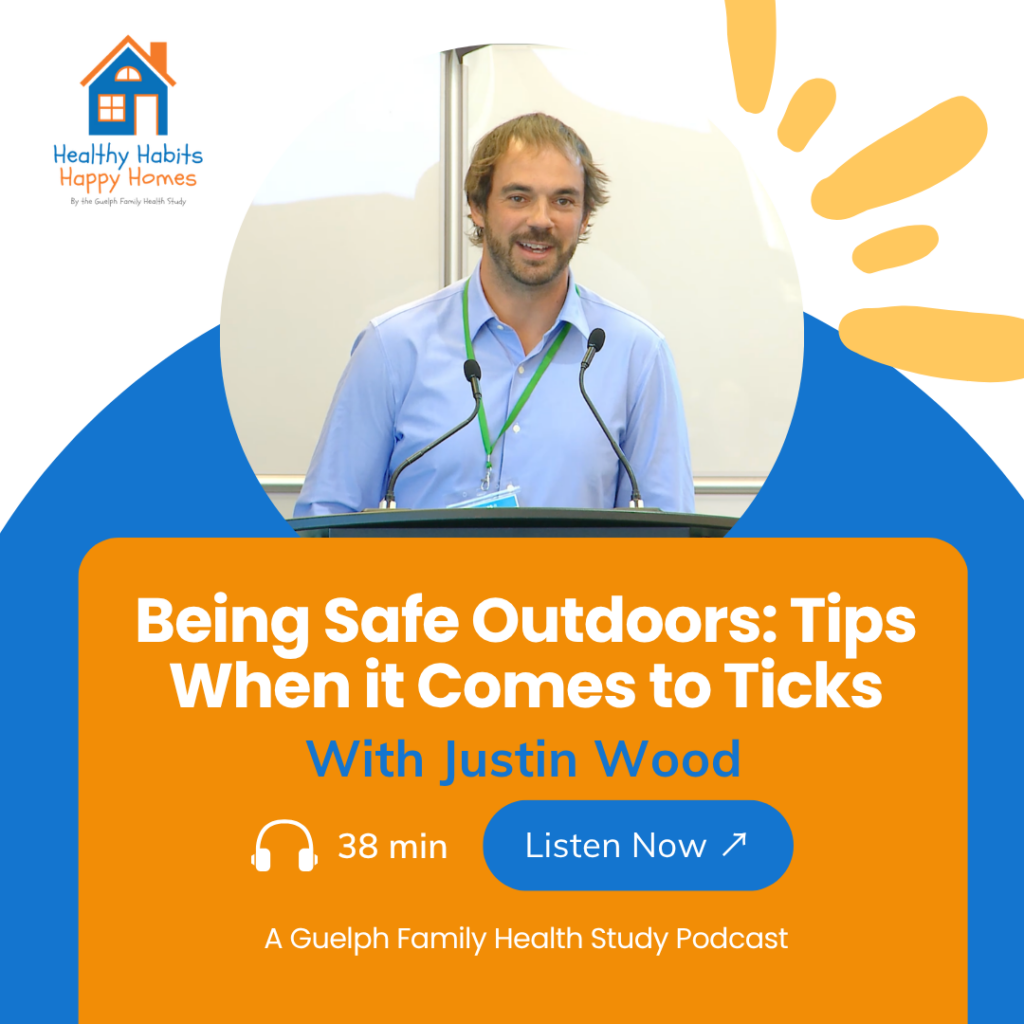
As warmer weather approaches, so does tick season. In this episode, we’re joined by researcher Justin Wood. Justin works at the University of Guelph’s Magnotta Lyme Disease Research Laboratory and is the founder of Geneticks, where he focuses on developing diagnostics for tick-borne diseases and advancing pathogen research. In this episode, we take a deep dive into ticks, Lyme disease, and practical ways to protect ourselves and our families while continuing to enjoy time outdoors this summer.
About Justin
Justin Wood is the founder and CEO of Canada’s first dedicated tick testing company, Geneticks.
He is also a research associate at the G. Magnotta Lyme Disease Research Laboratory at the
University of Guelph, where he works on the development of tick-borne disease diagnostics and
tick based pathogen research. A former Lyme disease patient, Justin is a passionate advocate
for Lyme disease awareness, and a dedicated professional committed to minimizing the spread
of Lyme disease and other tick-borne diseases in Canada. In his spare time, he likes to stay
active and spend time in the outdoors.
Transcript
HHHH Season 8 Episode 8
April 14, 2026
Justin Wood
Manahil (0:00 – 0:07)
Most of us think that ticks are a summer problem, but did you know that they also reach peak activity in spring and fall?
Heemani (0:08 – 0:15)
And they’re not just limited to hiking. Ticks can be anywhere and can even attach to you on your daily walk or at the neighbourhood park.
Manahil (0:15 – 0:21)
With Lyme disease on the rise in the last 10 years, tick education and prevention has never been more important.
Heemani (0:22 – 0:29)
But wait, what even are ticks? And what is Lyme disease? How can we prevent tick bites?
And what do we do if we find one on us?
Manahil (0:30 – 0:47)
Here’s the answer to all of these questions and more on this episode of Healthy Habits, Happy Homes.
Welcome back to the Healthy Habits, Happy Homes podcast. I’m Manahil.
Heemani (0:47 – 0:57)
And I’m Heemani. And today, we’re so excited to have Justin [Wood] join us. To get us started, Justin, would you be able to tell us a little bit about yourself, your current role, and how you got to where you are today?
Justin Wood (0:58 – 6:23)
Sure. Yeah. Thank you so much for having me on the podcast.
I’m really excited to be here as well and talk to you guys a little bit about ticks, tick safety, Lyme disease, that sort of thing. Yeah.
So, I guess to really understand my story, you have to go back in time a little bit. It started, I think, really when I was in university. I was a varsity athlete. I played soccer at Queen’s University. And I was pursuing a degree in biosciences as well. And in the summers to make money, I would go tree planting up in Northern Canada, spend the summers living in a tent, digging in the dirt and encountering all sorts of insects and arthropods and everything like that. And I remember in my last year, I came back from tree planting. And I just noticed that I had a lot of physical issues that I hadn’t had before. I started to have pain in my knees. I felt like I was a lot slower in everything I was doing, like athletically on the soccer field.
And things just felt a little bit different. And I didn’t really know what was causing it. And I brushed it off as, like, maybe I’m just getting older, which is kind of comical, because I was like 20 years old or 21. But maybe these are just like normal aches and pains in the progression of, you know, being an athlete your whole life.
So, I struggled with it, didn’t think too much of it. I graduated from undergrad, and I went to pursue a master’s in functional genomics at the University of Calgary. And I decided that I wanted to play soccer out there as well. I started to get back into that as well as… I took on a lot of… spent a lot of time in the mountains. I was doing mountain biking, skiing — or snowboarding — and all sorts of things like that. At some point, I had hit my head. I was in a soccer game, and I took an elbow to the head. And I expect I had a concussion. I expected it would heal somewhat quickly. And it didn’t. It took three or four months before I got back to normal. And then I started to have this sort of slower decline in health issues. And a lot of them were near logical. And a lot of them kept getting attributed to sports-related things.
And I thought, OK, I can kind of understand this. But in a lot of cases, the severity of the outcomes does not really match the incidents that are causing them. And I was having these like, you know, sometimes months to year-long recoveries from what felt like pretty innocuous hits. So I wasn’t completely convinced that was what it was.
And then things started to kind of just continue to deteriorate in other ways as well. Neurological issues. I had physical issues, a lot of body pain, and insomnia. You kind of name the symptom, and I had them developing. And it was getting more and more severe. I managed to finish my master’s degree, and then I applied for and was accepted for a Ph.D. at the Hotchkiss Brain Institute, doing neuroscience. And right before I was about to start, I just had this massive health collapse, and everything went absolutely horrible. I couldn’t walk. I couldn’t read. I couldn’t, you know, be in a room with multiple people. I couldn’t engage with my friends. I couldn’t really take care of myself. I had to obviously not pursue the Ph.D. I was really sick for years, and I didn’t really have an answer for why. I was bouncing around in the medical system. I probably saw 20 or 30 doctors in that time. Nobody had an answer for what was going on. I was getting more and more desperate. I hadn’t worked in two years, at least. I put my academics on hold. Lost a lot of, you know, friends because I couldn’t really interact or do anything like that.
And eventually I was sitting in a clinic that was, kind of, you know, kind of, for lost people, people that were falling through the medical, the cracks of the medical system. And it was me in there for what was being deemed post-concussion syndrome and a bunch of people in there that had been diagnosed with Lyme disease. And I was kind of looking around the room thinking, well, a lot of these people look pretty similar to me.
And so I talked to the doctors there. I asked if I could get tested for Lyme disease. They tested me. I came back positive and, you know, kind of, finally had a little bit of an answer for what was going on. Started treatment because I was so far down this path. Treatment was difficult and long, and we went through a long process, another couple of years of trying to find a treatment that worked and get better.
Eventually, I found something that, you know, kind of, pushed me over the edge, kind of, got me back a little bit to life. And I decided, because of that, I wanted to do something in this realm to try and help prevent other people from going through what I went through. So in the process of this, I met a lot of doctors and people working in the field. And I’d identified that there was a little bit of a lack in, like, if I got bit by a tick, I would want to know what diseases that tick carried to see if I need to be worried about contracting those. And there wasn’t really anybody offering that service. So I felt that my history academically put me in a good place to do that. And my experience as a patient also made me quite passionate about it. So I started the company Geneticks, which is a tick testing company, primarily. We accept ticks that have been removed from humans and animals, and we test them to determine what kind of pathogens they were carrying. And then people, with the help of their physician, can use that to determine what the next steps are. And then from there, I also connected with Dr. Melanie Wills, who runs the G. Magnotta Lab at the University of Guelph and started to work there as a staff scientist.
And now I’m straddling both worlds a little bit in industry and then also in the academic portion. So that’s kind of a long-winded story of how we got here, and I do apologize, that was probably longer than you were hoping for.
Manahil (6:24 – 7:23)
No, that was so interesting to hear. Also, also a bit painful to hear knowing how long a journey that you had to go on to find out what was wrong with you. Like, the symptoms just seem so general that you don’t know what’s going on. And, like you said, there’s something definitely missing in the medical system. So it’s so cool to help fix that. And it’s interesting, you know, looking back, that you were already studying something that would eventually help you do what you’re doing now and bridging that gap between industry and academia. We were talking about how important that is. So this is so cool. And we’re so excited to talk to you or hear from you to learn more about ticks.
So, just to start off super simple, can you just tell us what exactly ticks are? Where are they commonly found? How do they attach to people? Like, I’m assuming it happened to you during tree planting. And then what are some common tick-borne illnesses in our region?
Justin Wood (7:24 – 11:44)
Yeah, for sure. So, to start with, ticks are what I call an obligate parasitic arachnid. So a lot of people think they’re insects. They’re not; they have eight legs instead of six, and they have to take a blood meal. They have to find a host to feed on to progress through their life cycle, go to the next stage and then to reproduce, lay eggs and start over. They’re quite closely related to like mites and spiders.
Yeah, where they’re most commonly found, it depends on the species of ticks. So in Canada, the ones that are most concerned about are the black-legged tick for most of Central and Eastern Canada. So, from Manitoba across the Atlantic coast, we have the black-legged tick. And then in BC, we have the Western black-legged tick, which is like a cousin of that. These are the main vectors for most of the diseases that we encounter in Canada. There’s also the American dog tick and the Rocky Mountain wood tick, which we see a lot of, but they don’t really vector pathogens the same as black-legged ticks do. So we worry less about them, even though we see them quite commonly. For black-legged ticks, they tend to be in wooded areas, meadows, and grassy areas. They like cooler, damper environments. So they tend not to be out in the sun where they can get desiccated from the heat. That tends to be the one thing they really don’t like. So on hotter days and even when it gets really cold, they tend to hang out in the leaf litter where it’s kind of moist. There’s moisture down there, and they’re protected from the elements. So that’s where we usually find them. But the frustrating thing about them is that they can actually really be almost anywhere. They’re quite hard to kill, and anywhere that animals go. So ticks don’t move very far and very fast on their own, but they tend to attach to animals and, you know, they can move quite quickly or quite far like that. So anywhere that animals go, we can find ticks as well. You may think, “Oh, I’m in the city. I’m safe from ticks,” but in a local park where birds come, you can still encounter ticks and that sort of thing.
I think the next question was how do they find their hosts? How do they attach? Yeah, this is quite interesting. So again, the black-legged tick and most ticks in Canada are… they find their hosts through a process called “questing.” So they’re not really seeking out hosts and chasing them down and climbing onto them. What they’re doing is they’re kind of climbing up out of that leaf litter where they’re safe onto low-hanging foliage, shrubs, brushes, that sort of thing. And they’re climbing out to the end of those. And on their front legs, their first two legs, they have these really sensitive organs called “Howler’s organs.” And these can detect really minute changes, chemical changes in the environment, things like C02, respiration from animals, that sort of thing. And they use those to detect when potential hosts are coming in their direction. They orient themselves towards that. And then they wave those front two legs in the air. They kind of hang onto the leaf or whatever it is with the back legs. They wave the front ones in the air. And they have these tiny sticky hooks on the front of those legs. And as something comes by, they use those hooks to try and attach to it or grab onto it and then climb onto that creature as it brushes by, that sort of thing. So, they’re not jumping. They’re not flying. There’s a myth about ticks that they’re jumping from trees onto people. They’re definitely not doing that. They can’t fly. But they are waiting for things to come by and then using these sticky little hooks to attach to them as they walk by.
I think you were asking as well about common tick-borne diseases. And yeah, in Canada, the most common and most prevalent is Lyme disease for sure. That’s caused by the bacteria Borrelia Burgdorferi. We also see, vectored mostly by the black-legged tick, a couple of other diseases, including Anaplasmosis, tick-borne relapsing fever, and Babesiosis. And something that’s somewhat rare but quite severe is a viral infection that causes encephalitis from the Powassan virus or the deer tick virus. I would say those are the diseases most commonly vectored here in Canada, transmitted by ticks. There are some incidences of things like Rocky Mountain Spotted Fever, Q fever, Tularemia, and Ehrlichiosis. But they tend to be considerably more rare across Canada. And they don’t tend to be vectored by the black-legged tick either. They’re often vectored by the dog ticks or, in some cases, the lone star tick.
Heemani (11:44 – 12:48)
That’s a great overview of some of the things that people should know about ticks. And a lot of people just know about the basics. You’ve gone into a lot of detail about some of these things. I think one of the main misunderstandings is that even if you’re in a city, you can still be interacting with ticks. It’s not like you’re safe. I think a lot of people think that, “oh, if I’m going hiking on a trail or something in the outdoors,” that’s where they’re more like a little bit cautious. But even if you’re in your yard doing yard work, that’s still a place where you could be coming into contact with ticks. And so you said Lyme disease is one of the most prevalent diseases associated with ticks in Canada. And so you did talk about what it is, but could you expand a little bit on what some of the early signs or symptoms that people might notice are and also what typical treatment might look like?
Justin Wood (12:49 – 17:38)
Yeah, so Lyme disease, like I said, is by far the most common tick-borne disease that we see here in Canada. From our data that we collect from our tick testing, we see that almost 30% of black-legged ticks across Ontario are carrying the pathogen that causes it. And we’ve also— if you look at public health data— you can see that the incidence of Lyme disease is increasing every year quite dramatically. I think we’ve had over a tenfold increase in the last 10 years alone. And a lot of that, I think, is probably still being underreported. I think there are a lot of people who get sick with Lyme disease and don’t know they’re sick with Lyme disease, and don’t make it into the reporting. So it’s very common in black-legged ticks, and it’s becoming more prevalent in the human population as well. It’s definitely something to be worried about. Lyme disease is a bit of a complicated illness because it has multiple stages to it, and it has a lot of different symptoms that can be associated with it. There isn’t necessarily something really cut and dry that you can look at and say 100%, that’s Lyme disease. So in terms of symptoms in the early stages, a lot of times it can just look like flu-like symptoms. Someone might feel fatigued, they might have some joint pain, they might sort of feel sick, and they might not know why.
There is a certain rash that’s often associated with Lyme disease. It’s called the Erythema Migrans or the bullseye rash. And basically, what it is is an expanding red ring that over the course of a couple of days will grow larger and then often smaller again around the bite where the tick was embedded. That’s an absolute sure sign of Lyme disease. If you see that, you know for sure you have Lyme disease. That’s the only truly really diagnostic sign or symptom for Lyme disease. But the problem is, is that rash doesn’t occur in 100% of cases. In fact, it’s probably somewhere around— estimates you know can vary — but let’s say 40 to 60 percent might experience that rash. And when they do get the rash, it’s not always that perfect expanding ring. Sometimes it can look like a number of other things. So it’s not a perfect marker. As the disease progresses, so in the acute stages, like I said, the symptoms are often quite diffuse, and they can just look sort of like a, you know, normal flu or viral illness or something like that. As it progresses out of the acute stages, we get into what’s called the early disseminated stage. And basically, what’s happening here is that the bacteria that have been transmitted are starting to spread through the body. We might start to see new symptoms arise in this phase. And as the bacteria spread, it has tropism for different tissues, which means that different strains and different species of Borrelia will look for different tissues to hide in or to colonize to live in. So we start to see some different symptoms appear, and this is where things get really broad, because somebody may have, depending on what they’ve been infected with, they may have an arthritic version of Lyme disease at this stage. They’ll have joint pain, migratory joint pain, that sort of thing. Someone else may have a purely neurological manifestation. They’ll start to have headaches, sensitivity to light, sound, intolerance to exercise, that sort of thing. Other people may have cardiac manifestations. So you have this really, really broad range of symptoms, which obviously makes diagnosis even more difficult. And then from there, we move into what’s called the late disseminated stage. And this is where the bacteria have spread throughout the body.
It’s established in other places, and it gets really rooted in, starts to employ some of these mechanisms that make it much more difficult to treat. And things get really complicated in that phase. And in general, what we say with Lyme disease is that it’s much easier to treat early in the infection.
So in the acute stages, interventions are much more effective. As you move through early disseminated and late disseminated Lyme disease, you tend to have a worse prognosis, and it’s more difficult to treat the infection. So, in terms of treatment, with that in mind, in the early stages, it tends to be much easier to treat. So a course of antibiotics is the normal treatment for acute Lyme disease. In a lot of cases, the recommendation is two weeks of doxycycline or an equivalent like amoxicillin or something like that, depending on the guidelines. So there are the Canadian guidelines, there are international guidelines, the length of that antibiotic treatment may vary, but in general, it’s antibiotics in the early stages. And then as people move into the early disseminated and late disseminated, the treatment options become a little bit more controversial, because one size doesn’t fit all. We have people sort of trying different interventions. For some people, it’s longer courses of antibiotics. For some people, it’s different courses of antibiotics. And some people, as they kind of get more desperate, may look for what are probably considered more alternative treatment methods, just because those antibiotic therapies at that stage can be more likely to fail.
Manahil (17:39 – 18:00)
So like we said earlier, it still seems very complicated, and diagnosis seems difficult, but early intervention and catching it early on is very important.
I want to go back to something that you said. You said that Lyme disease has been on the rise rapidly in the last 10 years. Why do you think that might be happening?
Justin Wood (18:02 – 19:11)
Yeah, it’s a couple of things. I think one thing that plays in for sure that we can’t rule out is awareness of Lyme disease is increasing, and that means more people are going to get tested for Lyme disease and are being diagnosed, or they’re getting bitten by ticks and knowing they need to follow up with a physician, that sort of thing.
The other major player is climate change. Climate change is pushing tick populations north into Canada. It’s also allowing them to continue to expand here in Canada. So, you know, even over the last couple of years, we’ve been able to see a, sort of, in Ontario, a northwards expansion of the ticks away from Lake Ontario, where they first arrived, into areas further north, further east, further west, that sort of thing. And as that happens, the reservoir species which carry these diseases that the ticks pick up from and then vector to humans, their populations are expanding as well. And so that means that there are more ticks in Canada. More of those ticks are carrying the pathogens that cause these tick-borne diseases, and they’re spreading into areas where they’re contacting people more. So more people are being exposed, more people are getting sick, and then more people are going to get diagnosed.
Heemani (19:11 – 19:56)
Yeah, it’s definitely unfortunate that one of the many consequences of climate change is also now an increase in tick-borne diseases, which just really makes it so important for people to know about ticks and know, you know, what they should be doing. And, like you said, awareness has gone up. And, I can also say that over the years, I feel like there is more awareness and information about ticks, like in the news and on social media. I do feel like every year I am seeing a little bit more, and I’m learning more, which is definitely really great.
But based on the research that you’ve seen, are there certain demographics or age groups that are at more risk or more affected by these tick-borne illnesses?
Justin Wood (19:57 – 24:03)
Yeah, absolutely, there are. This is one of the benefits of running a tick testing company is that we actually collect a lot of this data from our users. So we ask them, you know, obviously their age of the affected person, as well as what they were doing at the time. And there is also companion data about these sorts of diagnoses from, like, the Public Health Agency of Canada. So we have data about the demographics that are affected and that are encountering ticks, as well as those that are getting Lyme disease. So, in terms of age groups, what we found and what’s mirrored by the Public Health Agency of Canada stats is that the young folks and the older folks are the ones who are most at risk and mostly being affected. So I think we saw that people or children from let’s say age one to ten were the demographic that was encountering ticks the most. And then again, in the 55 to 75 year old category. And I think what’s basically happening here is these are the generations that are out, you know, like, the kids are out playing in the grass, and the sort of older generation is less likely to be inside with technology. Instead, they’re often out for walks, they’re gardening, they’re doing that sort of thing. And then we have a drop-off. We don’t see a lot of affected people from age like 20 to 40. And I think a lot of that is that these people are doing less activities that are exposing them to ticks. But also, I’m less convinced that those demographics are seeking interventions if they do interact with ticks. So it may be just like a bit of a data skewing there as well, that, you know, a parent that’s really concerned about their child is absolutely going to follow up on that. And an older person is probably with, you know, more time on their hands. Maybe they’re retired, they’re not working, they’re probably going to follow up as well. Whereas this working demographic may be spending more time indoors, having less exposure, and then they may not have the time or, you know, the energy to follow up on these things. We may have a data gap there as well.
In terms of activities that people are doing, yeah, this is again something that we think is quite interesting and that we collect data from our users about. And the first thing that I would say about it is that about a quarter of the people who submit ticks to us, they have no idea where they got the tick from. They don’t have any event that they were doing, like, “oh yeah, it was probably this thing.” So I think that tells you that, you know, ticks really can be anywhere, and you don’t have to be doing some like really obvious activity like, you know, hiking or, you know, something out in the woods to have picked one up. The next most popular demographic is hikers. I think it goes without saying that they are probably one of the most exposed to it. And then a sort of interesting one is we’ve actually differentiated between people who are hiking and people who are just like walking around in their neighbourhood. So they’ve like distinguished to us that they weren’t out in the woods hiking, they were just walking around their neighbourhood. So about 15% of submissions come from people who were just out for a stroll. Maybe they were at a local park, something like that. Outdoor recreation, which, you know, is things like children playing, hunting, fishing, you know, ATV trails, mountain biking, that sort of thing. That accounts for probably another like 15% or so. But the interesting thing is that it is mostly made up of children playing. We don’t get as many submissions from adults, you know, and I don’t know if again, that is because they’re not being as exposed or just more likely that adults are going to not follow through on, you know, tick encounters. Then we have about 10% of our submissions come from people gardening and doing yard work. And then some small percentages of people getting them off of their dogs, you know, when they’re like grooming their dogs or something like that. People working in the outdoor industry, people going to their cottages and camping and that sort of thing.
So people do definitely have to be in the outdoors for the most part to encounter ticks, but there’s a really broad range of what people are doing. And a surprising amount of those encounters seem to be coming from sort of innocuous activities that people are doing in sort of residential areas.
Manahil (24:04 – 24:27)
Wow, that’s interesting. So what I’m hearing is that they can really be anywhere, and it can really happen to anyone, which is, you know, it’s annoying, but it just goes on to say why it’s so important to know about ticks.
Just a follow-up question. You mentioned dogs. I don’t know much about Lyme disease and pets, but could you talk a little bit about that?
Justin Wood (24:27 – 25:46)
Yeah, for sure. I’m less versed in the veterinary side of things. I’ll just say that as a disclaimer, most of my work focuses on either the vectors with ticks or the human side of things. But dogs can be quite dramatically affected by Lyme disease. It’s a real problem in dogs. Dogs are also more of a tick magnet than humans are. So if you were to go walking with your dog in the park, the likelihood of ticks attaching to your dog is much higher than them attaching to you. And that’s a) because dogs tend to be furry and b) because they don’t like to stay in the center of trails like we ask humans to do. So dogs often contract the ticks. And then what happens after can be variable. Dogs tend to have a stronger immune response, from what I understand, to the bacteria. So they don’t always get sick, but when they do get sick, it can be quite profound. You can also get Lyme disease in cats. I think it’s less common because I think cats are less likely to encounter ticks. But it’s definitely a lot of these pathogens are of veterinary significance as well. Anaplasmosis, ehrlichiosis, all of these things can affect pets as well. And it’s really important to check your pets for ticks. And if they’re, you know, displaying signs and symptoms, you should go to the vet. And there is pretty good veterinary testing to see if your animals have been exposed.
Manahil (25:46 – 25:54)
So, if, let’s say, there is a tick that’s on your dog, and now you bring your dog home, can the same tick then attach to humans?
Justin Wood (25:54 – 27:07)
It depends. Usually, the answer is no. So most of these ticks, they like to attach to one host. They like to feed to what’s called repletion. They fill up with blood. It takes, let’s say, 5 to 12 days. And then they drop off, and then they have to moult to the next stage. Or if it’s an adult female, they’ll try to lay eggs. And they’ll do that before they feed again. There are rare instances, and this happens more on dogs that are on tick preventative medications, where the tick will attach for a short period. It will get hit by that medicine, and it will back out. And then it will try to seek a new host. So there are times when a tick can preliminarily attach to a dog, can come inside the house, back out because of the medicine, and then seek a new host. It’s quite rare. I think the medicine is quite toxic to ticks as well. So a lot of them, once they’ve done that, they’re probably not in great shape to continue their life cycle. But that would be the instance where something like that could happen, is if they started on one host, something’s caused them to back out, and then they’ll seek a new host. But it’s rare. For the most part, once the tick has attached and started feeding, it’s going to stay there until it’s fully fed, and then it’s going to drop off. And then it has to go to its next life stage or lay a bunch of eggs.
Manahil (27:08 – 27:22)
And just one last question before we move on to prevention and treatment. I think all of us kind of associate ticks with being, like, a summer problem. We don’t really think about that in the winter. Is that true, or do we also need to be concerned in the wintertime?
Justin Wood (27:22 – 30:03)
Yeah, this is a really good question. So in the winter, you need to be less concerned. What you can kind of think of is when the temperature is below four degrees, it’s unlikely for the ticks to be active and seeking hosts. What they do instead is they bury themselves in the leaf litter, and they stay insulated there from the cold. The snow will land on top of that, create an insulated barrier, and the ticks are not necessarily dying under there. In fact, survival in the winter for ticks is pretty similar to the summer months, but they’re not active. They go into sort of a quiescent state, and they’re just looking to survive the winter.
But what I think people don’t necessarily understand is that there also is a seasonality to ticks in the warmer months. So the black-legged ticks that we’re most concerned about, the adults actually have two peaks in the year where they’re really active. They’re really active in the spring when the snow starts to melt, and the temperatures start to rise. So, from usually like maybe late March, early April, through May, June, July, we have the first peak of really high adult tick activity. And then it gets too hot for them. They don’t like it when it’s super hot. It causes them to dry out, and they dry out, and they die. So, at this time, they again become somewhat quiescent, not fully, like in the winter, but they’re not as active. They hide in the leaf litter where there’s some moisture, and they can survive. And then, as it starts to cool down again, we have another activity peak for them in the fall, usually in October and November. They’re really, really active here. They’re looking for blood meals so that they can feed and either survive the winter or progress through their life stage again.
But there are multiple life stages to ticks that we have to worry about. So we also have to worry about juvenile ticks, which are called nymphs. And they tend to be really active in the summer months, from let’s say June, July, August, and September. These ticks are quite a dangerous life stage because they’re really, really small. Like an adult black-legged tick is probably the size of a sesame seed when they’re not fed. But the nymphs are the size of a poppy seed. If you have any freckles and you look at your arm and you look at a freckle, that’s about the size of an unfed nymph tick. So these can be really dangerous because they’re really active at the same time that humans are active, especially in Canada. We’re out in the woods in the summer months, and that’s when these really small but very dangerous ticks are also really active. So there’s a lot, basically from when the snow melts in March until we get the really persistent freeze in, usually, December, you can encounter ticks. I’d say you’re pretty safe from them, but again, there are circumstances where we can encounter them. If you know, you heat your house with wood, and you have a wood pile, and that wood pile is where some ticks are taking refuge from the cold, you bring those logs into your house, it warms up, and any ticks in there could become active, that sort of thing. So there are instances where we can still encounter them in the winter, but it’s much, much more rare than the other months.
Heemani (30:24 – 30:50)
That’s definitely interesting. I had always thought that ticks were, like, most active in the summer, but I didn’t think that they would also be as active in October and November, which is, like, also a pretty large peak, which is good to know.
Let’s say that someone finds themselves bitten by a tick. What should they do? Like, what are some of the steps that they should take, including, like, safely removing the tick and testing, and then what kind of symptoms should they watch out for?
Justin Wood (30:52 – 34:42)
Yeah, for sure. So the first thing I always tell people is not to panic. It’s scary to see, you know, a lot of people consider them pretty gross. It’s scary to see them on you. It’s scary to see them embedded in you. But the first thing to do is not to panic, because we don’t want to improperly remove the tick. We want to make sure we do it in the right way so that we keep our chances of contracting pathogens from it as minimal as possible. So don’t panic.
And then my advice is always to calmly and safely remove the tick. There are a lot of myths and poor advice out there on how to remove ticks. You shouldn’t burn them. You shouldn’t put chemicals on them. You shouldn’t do anything like that. You shouldn’t squeeze them. The best thing to do is to use dedicated tick removal tools. My personal preference is very fine-tipped tweezers. With those tweezers, you can grasp the tick as close to the skin as possible. You try not to squeeze the body of the tick, but you can get right up against the skin where its kind of mouth parts are starting to embed. Grasp it firmly with those tweezers, and then pull directly up and out of the skin. It’s kind of important to note here that these ticks, they don’t come out very easily. So basically, what they’ve done is they’ve got little hooks on their hypostome, which is the needle straw that they feed through. And they’ve also kind of made a little cement mixture under your skin that kind of embeds them in there. So you’ve really got to apply some pressure, but firmly pull up directly out of the skin. Try not to pull on an angle because you don’t want to break any of the mouth parts off or anything like that. And up out of the skin until you kind of feel it pop and pull out of your skin. That’s the first thing. You’ve got the tick out.
That’s number one. My advice then is to put the tick into a sealable plastic bag or plastic container. You can save it. I recommend sending it for testing so you know what you are exposed to. Not everybody wants to do that, and I can understand that. And so if that’s the case, what I often recommend is to put it in, and you have it preserved in the freezer, and you can send it. So if you started to feel sick later and you were like, “oh, maybe it was because of this tick that bit me.” Well, now you haven’t thrown out the specimen. You can go find it, and you can get it tested if you want.
Next, what I would recommend is that people clean the area with an alcohol swab or something like that. Alcohol, wash it with soap and water, and clean the area. And then it can be helpful to mark where it is. And then the things you want to watch for are any signs and symptoms. If you start to see a rash there, particularly that expanding ring, that’s something to look out for. And any symptoms, like, you know, again, if you start to feel fatigued, you have headaches, you have joint pain, you have myalgia, you have things that you don’t normally experience. That’s a sign that maybe something is happening, that you may be infected. But again, this is difficult because I think a lot of us, if we’re concerned about something, we might kind of manifest some of those symptoms. And also, they could be completely unrelated. So those are the first steps. And then some people will do a prophylactic dose of antibiotics. They can go to their doctor, and they can say, “I was bitten by a tick. I’d like to prophylactically treat this. I don’t know if it was carrying any pathogens, but I do know that treatment interventions are most useful in the early stages.” You can have that conversation with your doctor. There is serological testing for Lyme disease and other tick-borne diseases. But the problem with it is that it’s not indicated for at least six to eight weeks. And this is because your body needs to develop antibodies towards that which can be detected on a test. And that takes at least six to eight weeks. So in this early stage, where we really want to treat, the serological testing is not particularly useful.
So I think the best thing to do if you’re concerned is either to test the tick so you can know exactly what you’ve been exposed to, or to have a conversation with your doctor about next steps prophylactically, what symptoms and signs to watch for, that sort of thing.
Manahil (34:43 – 35:00)
And before we talk about some preventative measures that people can take against getting bit by ticks, could you share like some tips for checking for ticks when you’re spending, after spending some time outside? I’m always scared that there’s like a tick on my bag and I just can’t see it. And then it’s going to be too late.
Justin Wood (35:01 – 35:54)
Yeah. Yeah. I think the easiest way, which isn’t always possible, is if you have a close friend who can help you out. So as you said, we can’t always see the places that ticks are going to be. So if you’re in the outdoors and you’re with people, it’s good to check each other. When you get home, you can do a lot of these checks in the mirror, that sort of thing. But there are areas that ticks are more likely to embed in as well. So ticks like vascular areas, and they like softer skin areas. So some of the places that ticks like to find themselves are like the backs of knees, groin areas, armpits, neck, and behind the ears. And then I’ve heard that a number of people get them in their hair and their scalp, which can be particularly challenging if you have long hair. So those are kind of the main areas I tell people to check, but you should look everywhere because they can embed almost anywhere. And they may just be walking around as well, looking for that soft area to embed.
Manahil (35:55 – 36:02)
And then to avoid them embedding in the first place, what are some preventative measures that people can take?
Justin Wood (36:03 – 38:31)
Yeah, there’s a fair amount. I think the biggest thing is to be educated on ticks and know where they are and how they’re finding their hosts. So we talked a little bit earlier about questing and the environments that ticks tend to be in. So what I tell people is if you’re going into the outdoors and you’re hiking, especially, stay in the center of the trails. Try not to go bushwhacking into the bush. Stay out of leaf litter. Try not to walk along with your legs touching against the plants on the side of the trail because that’s where most of those ticks are waiting and looking for hosts. So number one is being smart about the areas you’re going into and then making the right choices when you’re in there. That being said, we can’t always do that, and we’re still going to encounter ticks no matter how careful we are.
So there are a number of things we can do to try to keep them from attaching to us and biting us. We often recommend people wear tick-safe clothing, which is generally long sleeves and long pants. People will tuck their pant legs into their socks and wear light-coloured clothing. And the idea for this is that if you’re going to encounter those ticks, they’re going to get on you. They’re going to be on your clothes. And if it’s light-coloured clothing, you’re going to have an easier time spotting them than on dark-coloured clothing.
And then you can remove them, brush them off, whatever, before they find an opportunity to embed in your skin. I tell people all the time to do frequent tick checks when you’re out. So every 15-20 minutes, just have a look at your friends, yourselves, check your exposed skin, check your clothing, make sure there’s no ticks on you. If there are, again, try to get them before they embed, remove them, that sort of thing.
There are repellents that people find quite effective. In particular, my recommended ones are anything containing icaridin or picaridin. Things like PyActive or Combat Spray tend to work quite well. And then people also recommend 15-30% DEET, but I don’t think it works as well as icaridin and picaridin for repelling ticks. There are some clothes that have been treated with permethrin. Ticks absolutely hate permethrin, so some people will opt to wear permethrin-soaked clothing. And then, again, when you get home, do a really thorough tick check. And I always recommend people put their clothes in the dryer and put it on high for 15-30 minutes, because the thing that kills ticks better than anything else is heat and desiccation. So if you put them in a hot dryer, if they’re on your clothes, it’s going to kill them. Rather than if you put them in your dirty laundry basket, they’re going to survive in there, they’re going to find their way out, and they could attach to somebody else in the house.
Manahil (38:32 – 38:45)
Okay, well, those are all the questions we had for you. Thank you so much for answering them. I think we both know a lot more about ticks now, and are feeling more prepared as spring is coming up.
Justin Wood (38:45 – 38:47)
Fantastic, I’m happy to hear that.
Heemani (38:47 – 38:55)
We hope you found this episode of Healthy Habits, Happy Homes helpful. Follow us on Instagram at Family Health Study and Facebook at Guelph Family Health Study.