

Facts of Fibre with Mairlyn Smith
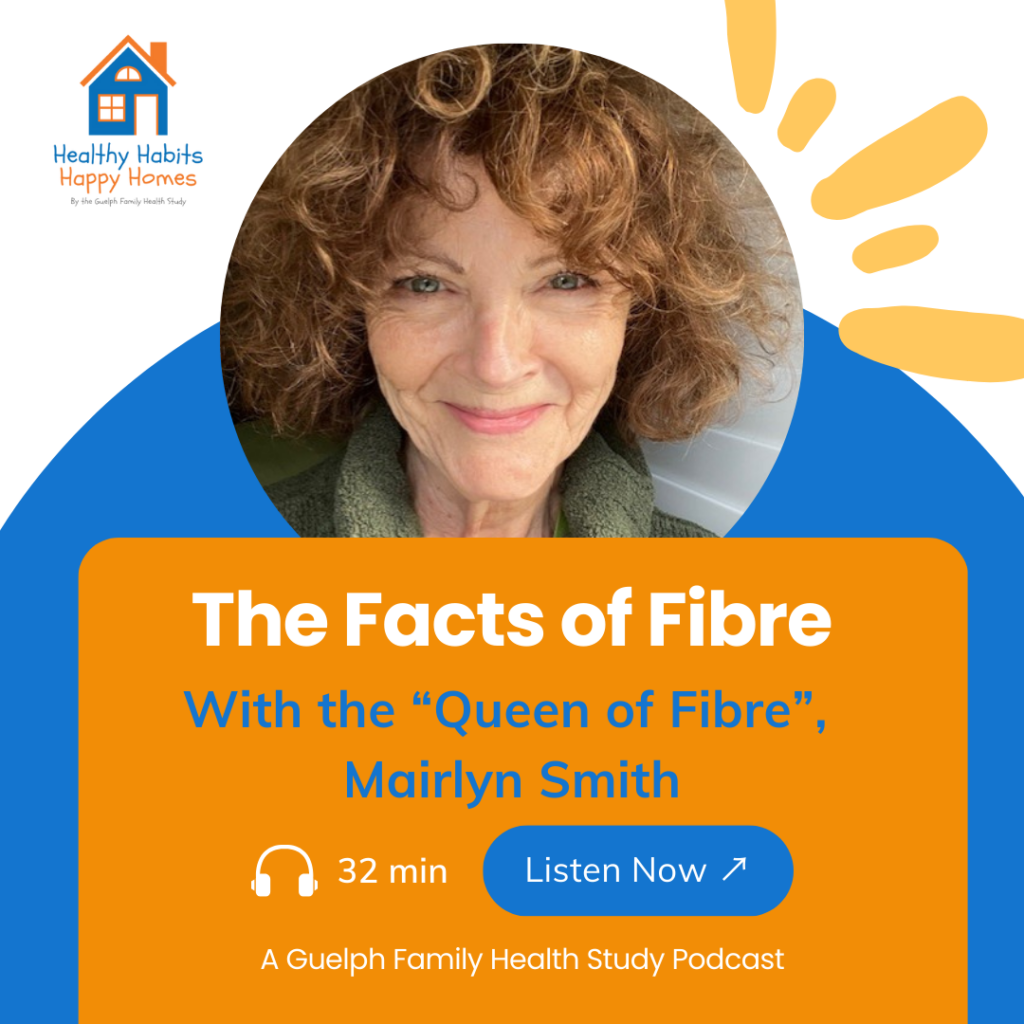
Join us for this awesome episode all about fibre with none other than the Queen of Fibre herself, Mairlyn Smith. Mairlyn is a professional home economist and food writer, and a familiar face on Cityline and Breakfast Television. With a background in acting, she brings humour and warmth to everything she does including this episode. We dive into what fibre is, why it matters, and share practical, everyday tips for getting more fibre into your diet for you and your family. And of course, we couldn’t miss talking about her world-famous fart walk!
About Mairlyn Smith
Mairlyn Smith is the only professional home economist and food writer in Canada that is also an alumnus of the Second City Comedy Troupe making her a popular TV and media food personality, and the self proclaimed funniest professional home economist in the world.
In 1976 she graduated with a degree in Home Economics from the University of British Columbia. She then returned to UBC and completed her Teaching Certificate before going on to teach Home Economics and head the Department of Fine Arts at Balmoral Junior High.
Unable to shake the acting bug, Mairlyn enrolled at the American Academy of Dramatic Arts in California. Then, like most Canadian actors in the 1980s, she moved to Toronto to find work. Mairlyn has been seen on over 100 television commercials, performed on live stage including the Second City Comedy Troupe, and has been in many TV shows as well as films. Her versatility in acting and cooking with a comedic flair landed her the job as a host of Harrowsmith Country Life and a subsequent Gemini Nomination.
The author of eight best selling cookbooks, Ultimate Foods for Ultimate Health and don’t forget the chocolate! which she co-authored with dietician Liz Pearson, won Gold at the Cuisine Canada Cookbook Awards making it the first healthy book to ever win Gold at these prestigious Canadian Culinary Awards.
Her website: Meet Mairlyn – Mairlyn Smith
Transcript for episode
HHHH Season 8 Episode 3
November 17, 2025
Mairlyn Smith
Heemani (0:00 – 0:04)
Did you know that fibre is one of the most important nutrients for long-term health?
Manahil (0:04 – 0:14)
Yet, most people only get half of the recommended amount. Today, we’re diving into all things fibre, including what it is and why it matters, with the one and only “Queen of Fiber.”
Heemani (0:15 – 0:22)
We’ll also get into practical tips like how to easily add fibre throughout your day, affordable fibre-rich foods, and kid-friendly options.
Manahil (0:22 – 0:42)
And, of course, we’ll ask about her viral “fart walk.” And if you don’t know what that is, well, you’re about to find out. Let’s dive right in.
Heemani (0:42 – 0:52)
Welcome back to the Healthy Habits, Happy Homes podcast. I’m Heemani.
Manahil (0:52 – 1:02)
And I’m Manahil. And today, we’re so excited to have Mairlyn Smith joining us. Hi, Mairlyn. Thank you so much for joining us. And, as you know, me and you are basically best friends now, because we did spend three hours on a GO train together.
Mairlyn Smith (1:03 – 1:14)
Which was really, really fun. We did the GO bus, we did the lineup, the run to the GO train, and the GO train home.
Yes, it was an adventure. It was a highlight.
Manahil (1:14 – 1:29)
I just love that I bumped into you and that we were able to talk and get this podcast scheduled. For those of us who don’t know who you are, could you just give us a very brief introduction of who you are, what you do now, and how you got there?
Mairlyn Smith (1:30 – 3:15)
So, how do I start? So, I wanted to be an actor. And my parents were astounded and horrified. And so, they encouraged me to go to university. And so, I did. I became a home economist. I have a bachelor in home economics from the University of British Columbia. But I always wanted to be an actor still. And I did a lot of stuff.
So, at one point in my life, I decided I didn’t want to die never knowing I hadn’t done my acting. So, I taught school for a couple of years as a home ec and drama teacher in Vancouver. And so, then I came to Toronto and it changed my life. I got into Second City, which is a comedy group that does improv. And based on that, I had a career as an actress for quite a while. I don’t know, I guess about 20 some odd years. But, when you turn 40 as a female in the acting world, you might as well just disappear. There’s no parts for people over 40 if you’re a female. So, then I switched my career and I went back to my food roots.
And I started doing cookbooks and I was on TV. Always, sort of, focused on healthiness. You know, you are what you eat.
When I was at university, when I went to UBC, I was really impressed by one of our professors who was, I thought, you know, 40. And actually, he was 60. He looked that good. And he was a vegetarian. And I was like, “I’m signing up out of vanity. I’m going to be a vegetarian.” I was only vegetarian for about 20 years. But anyway, I’m digressing. Anyhow, and then I just do TV now.
And I, you know, I try to encourage people to eat healthy. I always wanted to go back for my master’s and bumped into Dr. Alison Duncan at an event. We chatted. And here I am at Guelph going for my masters of Human Health Sciences. Yeah.
Heemani (3:17 – 3:34)
That’s amazing. Thanks so much for sharing, Mairlyn. We’re so excited to have you here today. And we can’t wait to learn more about fibre. And also, I had Dr. Duncan for a nutrition course last year, actually, in my undergrad. Such an amazing prof. Absolutely amazing. So I hope your master’s goes amazing.
Mairlyn Smith (3:34 – 3:59)
Well, I’m very lucky that she’s my advisor, too. And she’s honestly been a champion. And she’s made my dreams come true. I mean, like, unless I flunk, you know, and then that’s on me. But, you know, the way things are going, I’m hopeful that I will finish this in another year or so. But it’s because of her and her belief in me. And I think we all need a champion. And I’m very lucky to have her as mine.
Heemani (3:59 – 4:17)
Yeah, that’s great to hear. Mairlyn, we know that you call yourself the self-proclaimed “Queen of Fiber.” And so we were kind of just wondering, how did you give yourself this title? And then also, what was the moment that you decided to, I guess, like, dedicate your career on fibre, or to fibre?
Mairlyn Smith (4:17 – 6:05)
So, the self-proclaimed “Queen of Fibre” title was an evolution. So, people started calling me the Fibre Lady and, you know, the woman who always knew about fibre. And, all of a sudden, the idea that the Queen of Fibre was funny.
So, you know, my background is in Second City. And so meanwhile, while I was on City Line, which was a daytime television show I was on for about 15 years, they asked me if I wanted to pose for a portrait, which was of, you know, anybody in history. And you had to go to this website and you pose to match somebody’s body. And then the artist would paint your face into it. And so, I picked this queen. And so, we have this huge photo in our bathroom because as a Queen of Fibre, that’s where I should be. So, it’s in the bathroom, in our guest bathroom. People say I’m watching them when they were in there, which is kind of weird. And then we just sort of started going with it. There’s a whole bunch of reels on my Instagram a long time ago where I actually rented a costume as the Queen of Fibre. And I would talk “like this” and tell you,“you know, you should really eat apples. You know, it’s really important if you just one thing today, have an apple.”
Anyway, so it was really funny. And, you know, my Second City background and the nutrition information all kind of rolled into one. So, that’s where she, kind of, started. So, she’s kind of like another personality that I have. So, she’s very funny, very direct and doesn’t take any nonsense from anybody, where I’m, kind of, sweeter. You know, like, I would never say, you know, “off with your head if you don’t eat an apple,” because that means you’re a stupid idiot. You know, so I would never say that, you know, I would say, “it’s really important to have an apple a day because it’s really good for you.” You know, just totally. But the Queen of Fibre is kind of ruder.
Manahil (6:06 – 6:39)
[laughter] Well, I love that. I love that story. And I’m going to have to scroll on your page to find this picture because now I want to see it really badly.
But yeah, and we’ll talk more about fibre. But we did want to address the elephant in the room, which is, you know, your fart walk. And for people who don’t know about the fart walk, I was going to just play a short clip of the of the video for them. So, I’m just going to play that.
[clip plays] Mairlyn Smith (6:40 – 6:56)
Going for a fart walk after dinner is something that’s going to help you age wonderfully. And if you follow me, you know that my husband and I go up for fart walks most nights after dinner. So about 60 minutes after we’ve eaten, we put on our running shoes and off we go. Now, why do we…
Manahil (6:57 – 7:09)
OK, so that’s the short clip of the fart walk, Mairlyn. Could you tell us the story behind what led you to make this video and I guess everything that came after it?
Mairlyn Smith (7:10 – 11:31)
So, we’ve been going on fart walks forever. You know, we had a dog, you know, we would say, you know, “you want to go for a walk?” And we’d end up farting. So, we just started calling it a fart walk.
And because my husband and I are both actors, we have an actor background, we make up names for things like the bathroom on the main floor that has the picture of the Queen of Fibre in it is the guest bathroom. And we call that the Poo Poo Chamber, you know, so it’s just like stupid names for things. Whatever makes you laugh, right? I mean, we’re very silly and I think that’s one of the reasons we’ve stayed young. So, we started calling it… just let’s go for a fart walk because that’s what was happening.
So, then the pandemic came. So, I did this for years and sometimes I’d post them, you know, but as a story, not as a as a real. Then the pandemic came and we decided that during the war in World War II and the Korean War, they would send celebrities over to where the soldiers were to entertain them. And so, we felt as two actors, we should be doing reels that were entertaining and not so, you know, maybe not health conscious, well, health conscious, but like, you know, just stupid stuff. I mean, the stuff that we normally do all the time that is so embarrassing. Why would you ever put it out there? So that’s what we started to do. And then I so I started putting the fart walk on my stories more and more and more and people go, “Oh, that’s so funny.” But that’s all it was.
So, then, in 2023, in February, I fell on black ice and I hit my head on the sidewalk and I had a major concussion, a pretty bad traumatic brain injury. And I didn’t think I’d ever be able to do anything again. Like, I couldn’t walk outside without getting dizzy because my shadow made me dizzy. So, the progression of where I was in 2023 and where I am now is like totally different. I mean, I’m almost back to who I used to be. And one of the things my neurologist told me was that I had to challenge my brain. So, the old school of getting better from a concussion was sit in a dark room and don’t do anything. And the new one is like you have to you have to stretch that muscle again. You have to work that muscle.
So, as I would like to work the muscle and learn new things and stuff, he said, “you know what? What can’t you do yet?” Like, “oh, well, I can’t walk and talk and look at my phone anymore. I get too dizzy.” So, I hadn’t been doing reels where I was moving, right? Or anything like that. It was always stationary. So, he said, well, you better practice. So, I started practicing — just I didn’t put anything out because I usually would fall over. So, that’s not all that, I mean, it’s entertaining, but it’s not nice.
Anyway, so then this one day I thought, you know what? I think I’m feeling pretty good. I’m going to go do a reel. And because I’m an improviser, I usually do just one take. So, I’m going to go do a reel and I’m going to talk about the fart walk. So, I just went out there and I started doing it. And as I said it, it occurred to me that of all the things I’ve done — you know, the eight cookbooks that I’ve written, won awards in writing cookbooks, you know, encouraging people to help eat healthy — wouldn’t it be crazy if all anybody ever remembered me for was the fart walk? And I just laughed my head off and I posted that. But, that’s what I did.
And then it went nuts. And I don’t know why. Like, maybe it was a #fartwalk that did it. I don’t know. But, like, literally, my niece sent me a message all the way from Vancouver to go, “Auntie Mimi, you’re famous.” It’s like, what? And so I started looking and I was like, “what? I have what?” And so, yeah, I think it’s got over 14 million views on my own Instagram. And then it was all over social media on TikTok.
And OK, it was — it’s crazy, but I did get people off the couch because that’s all I really wanted to do. And 60 minutes is a long time to wait. You don’t even have to wait that long. You could, you know, 10, 20 minutes after you eat, go for the walk. But it got people off the couch. And people are saying it’s made a difference in their social life, in their mental health, in their gas situation. And it also lowers your chances of developing Type 2 diabetes. So, it’s kind of hashtag winning all over the place.
And fart walks are funny. I mean, it’s just funny. And, you know, every time I walk now, I mean, somewhere on the street, someone will go, “are you farting?” You know, I don’t even know them. And they’re saying this to me. So anyway, so yeah, so I mean, I’m now known as the “Fart Walk” lady. So, yes, yes. And that’s it. It could be worse.
Manahil (11:32 – 11:58)
No, that’s, that’s such a funny story. And I love that you shared it. I remember seeing the fart walk on my page and people were making videos to the sound. I didn’t know that it was you who had said it. And when I found out, I was like, “oh my god, this is crazy. It’s such a small world.”
But okay, so, now on to our topic of the day, which is fibre. We want to start …
Mairlyn Smith (11:58 – 12:40)
Hang on. Can I just backtrack? I want to backtrack one thing. So, what happened was that like, Chrissy Teigen did a reel to my voice. And, like, all these, sort of, famous people were, like, doing either lip syncing with my voice coming out of their face, you know, which is weird, so I think that’s the other reason it got so much publicity. And I mean, and then there was I got interviews, Mariel Hemingway interviewed me— all these like crazy people interviewed me or that they started talking about me on their podcast. So, I think that was another reason why it exploded. But I mean, come on, “bite me, Chrissy Teigen!” Yes! She did a fart walk real. I mean, I was like, “oh my god, I’m such…” Oh, anyway, it blew my mind. Anyhow, okay.
Manahil (12:40 – 13:03)
Yes, no. And I, yeah, that definitely contributed to it. But, it’s a great message. So, I’m glad that it got so big, as it did.
Yes, as I was saying, we’re going to get right into our topic today. So, we want to start super simple. Could you just tell us very quickly, like, what is fibre? And like, how much of it do we really need?
Mairlyn Smith (13:03 – 14:32)
So, fibre is the undigestible part of a plant. So, if you’re a plant, you’ve got fibre in you. So, you know, beans, legumes, seeds, nuts, fruits, vegetables, whole grains — that’s kind of your fibre family.
And women, you two would be in that category, like, it’s pretty much anybody 19 and up for females who should get about 25 grams of fibre a day, and men should get about 38. But, if you’re living with Type 2 Diabetes, they recommend 30 to 50 grams a day, because of its effect on blood sugar and reduction of cardiovascular disease, because those two tend to go, together. If you’re a Type Two Diabetic, you have a bigger chance of developing heart disease.
So, those are the parameters. But I personally probably have 40 grams a day. I get 10 pretty much at every meal. Breakfast is usually my biggest one.
But I think it’s really important to know that if you eat too much too soon, you could get horrific gas, horrific stomach cramps, even if you went for the fart walk. And you really have to make sure that you’re adding more water to your diet when you up your fibre. So, if you went from — most people are getting half of that — if you went from 16 grams of fibre a day, which is kind of average, to like 25, even in the same day: not a happy day, you know, I mean, you might not be able to leave your house the next day, because…for what’s going to happen, right?
So, go “slow and low” when you’re adding those little bits of fibre.
Heemani (14:33 – 14:55)
Yeah, I feel like that’s like the same for whenever you’re starting anything, like, you have to start so, like, if you’re starting to, you know, go to the gym or exercise, you can’t just do it right at once. You have to start slow. So, it’s the same thing for fibre.
And then I also wanted to ask you, you told us how much we should be getting. Is there, like, do you use a specific tracker to see how much fibre you’re getting?
Mairlyn Smith (14:56 – 15:24)
I think, because I’ve done this so long, I just know, you know, I have kind of a vague idea. Once somebody analyzed my diet, just because she thought it would be funny. And that day, I’d gotten 50 grams of fibre. So, I’m not really sure where I am. But I think anytime that you use a tracker just to get used to it, I think is a good idea. But that’s a lot of math for a lot of people, like, a lot of people just want to say, “okay, I should have a handful of this or a handful of that or that.”
Manahil (15:24 – 15:31)
Okay, that makes sense. And while we’re talking about what fibre is, could you define insoluble versus soluble fibre?
Mairlyn Smith (15:32 – 16:35)
So, soluble fibre is soluble in water. So, it absorbs water and becomes a gelatinous goo. Insoluble fibre doesn’t, and it keeps things kind of moving along your GI. So, you need both, you know, especially if you have GI problems, it’s probably really good to eat more soluble fibre than insoluble. But you’re always remembering that no matter what kind of fibre, you’re going to add more water.
Now, there’s two extra fibres that we know about now. There are two more types. One is called fermentable. And that’s basically — it’s going to form those short chain fatty acids in your gut lining, send messages to your brain. And then there’s something called resistant starch, which is another type of fibre. So, they’re all kind of in this umbrella of fibre. But I think if you just focus on soluble and insoluble, you’re on your way.
I mean, start off slow, like you mentioned, going to the gym, start off slow. So, start off slow with this, too. I think too much information is, like, “I’m not going to do any of this,” you know, so, just think about soluble fibre and insoluble.
Heemani (16:36 – 16:51)
I mean, usually when people think about fibre, like, the one and only thing that they really think about is, you know, good bowel movements and, like, you know, helps prevent constipation, things like that. But what are some of the other, like, hidden benefits of fibre that you think people should really know about?
Mairlyn Smith (16:52 – 17:44)
Well, I think the biggest thing that came out in the last couple of years was this meta-analysis, they showed that all causes of mortality were reduced by eating a high fibre diet. And so it’s an extraordinary food. You know, I mean, like, that something is in a food that we can actually improve our longterm health by eating our way towards that.
Now, it’s not the only answer. You know, you got to get sleep. You got to reduce your stress. You know, you got to have friends. You got to be… so there’s a whole bunch of stuff. But if you looked at the big circle, I’m always saying that fibre is the biggest key in the food element. It helps reduce your risk of developing Type 2 Diabetes. It helps reduce your risk of developing cardiovascular disease. And it helps reduce your risk of developing certain cancers. So, it is more than just having an epic bowel movement. You know, it is all about those other things that it can do.
Heemani (17:44 – 18:01)
I’ve learned in previous classes, like, about the gut microbiome and how that can have an effect on like your brain and your mental health. Do you know if fibre, you know, helps decrease certain mental health conditions or, you know, if it does anything for the brain?
Mairlyn Smith (18:02 – 19:09)
The research is really new on the link between mood, mental health and what we eat, considering that your microbiome is, like, so important, right? So, it’s a new thing that we discovered. We didn’t know this. We didn’t know anything about this when I went to university. So, this is all kind of a new science. And when I wrote Peace, Love and Fibre, which is my book on fibre, my love letter to your colon, when I was doing the research back in 2017, those studies were just starting. And, you know, from a science background, you want to have big studies for long periods of time, lots of people in the population. So, the studies that they’re showing are very small. And so, they’re very hopeful. And I’m going to tell you right now that I do believe that what you eat affects your mood. But until we have that solid science to say, “yes, definitely, this is true,” then I can’t really comment on it. But I’m very hopeful. I mean, you might notice that if you don’t eat well, you feel like a bag of dirt with a belt on, right? So that’s, you know, that’s just a study of one. But there is something to it.
Manahil (19:11 – 20:07)
Well, I don’t think I’ve heard of the mental impacts of fibre before. So, that is really, really cool to know. And I like that we’re emphasizing this nutrient or that you’re emphasizing this nutrient so much because like you said, it is so important. But right now, I don’t think that many people know about it or are able to include it in their diet. Like, you mentioned, only like, people are getting half of what they need, which is pretty concerning. And I think it’s interesting how, like, protein is such a big thing now. But most people are getting more than enough, like especially in Canada. Just the dichotomy of those two things is very interesting to me. So, we want we want our listeners to be to know the importance of fibre and also to have some practical and affordable tips for adding fibre to their diets throughout the day.
So, we’re wondering if you had any tips that you can share for adding fibre, like, maybe at breakfast, at lunch or on the go?
Mairlyn Smith (20:07 – 23:55)
It’s a great question, because unless we have, I mean, it’s one thing to know the knowledge, but to put it into action is always that next step. Right? So, for breakfast, if you’re having cereal, then adding ground flaxseed is a gift. It’s a gift to your colon. It’s a gift to the whole shebang. It’s going to help your blood sugars. It’s going to help. It’s an extraordinary food. We grow it here in Canada. You can buy it and grind it yourself or you can buy it already pre ground. You store it in the refrigerator. If you’ve never used it before, you can store it up to three months in the fridge or you can put it in the freezer. It’s OK to start off with one teaspoon a day for, like, a week. See how that does. You might you might not notice anything. Have extra water the next week. Add another teaspoon. So, now you’re up to two. And then hopefully by the end of the month, you’re up to a tablespoon. Now you can work your way up very slowly to two tablespoons a day, and that would be a wonderful little tweak. It’s not a big ask. You just sprinkle it on your yogurt, sprinkle it on top of your cereal or stick it in a smoothie. So, that would be your morning hack if you want to call. I hate that word, but there it is.
OK, so that’s your first thing. So, now then you’re in your, sort of, snacks. If you’re going to pack snacks, pack nuts or seeds. So, I always pack pumpkin seeds and nuts in my backpack. And when I feel like I’m going to murder somebody, I just have a handful of those. And it’s an amazing fix, right? Sometimes I add dried fruit to that to just, sort of, have a little bit of sweetness, like, I’ll put a date in or some prunes. Once again, I’m getting fibre and the fibre from the seeds and nuts. But the pumpkin seeds have protein, so do the walnuts, but they have more protein than the walnuts. So, you’re getting that balance. You’re getting healthy fats, protein and a piece of fruit. OK, or you could have it with an apple then.
And then, when it comes to your lunch, you know, everybody goes, “oh, I hate salads.” Well, you know, OK, so what about hummus and cut up vegetables? I mean, I eat that. We actually have that for lunch with our whatever protein we’re having on a very regular basis. So, hummus is convenient. You can make your own. I make the worst hummus, so I buy mine. And we always have cut up vegetables. And as a student, or even as who I am right now, as a student who’s 71, I cut up a big container of vegetables and throw it in and keep it in the fridge. And so, it’s already done. So, once a week, you know, chop up a whole bunch of stuff and it’s ready to go.
And then when it comes to dinner, just make half your plate vegetables and a quarter should be a whole grain. So, whether it’s barley, brown rice, whole grain pasta, quinoa, which is a pseudo cereal, buckwheat, which I didn’t know was a pseudo cereal— I always thought it was a grain that didn’t have any wheat in it. I learned that yesterday in class. So, any kind of cooked grain that’s, you know, your culture loves, but the whole grain version. And then as a snack, have fruit.
So, it’s that elimination of all the other stuff, you know, the junk, because when you look at the longterm health of, like, a Mediterranean diet, they’re very heavy on the fruits, vegetables, whole grains, legumes, all those guys. We had a lot of beans in our house, too. And we’re very low on the processed meats. But the added sugars and the added alcohol, those are things that we never talk about in the Mediterranean heart healthy diet. It’s, like, you want to get rid of that. Like, they have very low eating of that where the rest of the stuff is really high. So, aim for aim for back to basics and make it easy on yourself.
So, I think chopping things up and having it ready is a really great idea. And also having like a tub of hummus, you know, there’s not a ton of protein in it. So, we don’t call that lunch. It would be a snack unless you have protein with it.
Heemani (23:55 – 24:13)
Those are some great tips. I also I love the ground flaxseed in your cereal. I usually eat cereal every morning. And so this is definitely something that I want to try. So, I’m excited for that.
Do you have any tips for including fibres in the diets of, like, picky kids?
Mairlyn Smith (24:14 – 26:22)
OK, so my daughter-in-law was is a very picky eater, her and my son, they decided that their daughter was not going to be that picky eater. And how they did it was they just gave Emma everything. So, Emma self feeds. She’s 20 months now and she eats everything.
And this is from a mother who is a picky eater. And so, we know that children’s taste buds are so hypersensitive that if they don’t like something on the first taste, that might change. So, you know, you keep offering. So, that carrot, “bleah,” but maybe on, you know, the 10th attempt. “Oh, you know what? I kind of like these carrots now.” So, never giving up on a picky eater and not and not just giving them only the things they love, like, make sure that that plate has got a lot of choices on it.
And, sadly to say, and most people learn, most children learn their eating habits from their parents. And so, if you see your parent not eating something, well, you’re not going to eat it either. So, if you’re as a parent, you have more of, you know, an inclusive plate where there’s a whole lot of stuff on it, it’s going to encourage your child to mimic you. And because it’s a learned behaviour, I mean, you don’t normally just — you know, you’re not born with hating bananas— you know, you either never got a banana or the first time you had a banana, it was disgusting. And then, your mother quit. So, if your mom had, you know, or your parent or whoever, your caregiver, had continued to offer the banana, you might eventually try the banana and you might eventually like it. So, it’s like, don’t give up on a picky eater. Try to show them that you’re eating that stuff, too. As a result, my daughter-in-law now eats more variety of foods because she’s been giving them to her daughter. So, it’s kind of been a two-way street. It’s very exciting. I cannot get her to like fish though, which is really sad to me. My daughter-in-law hates seafood, but she was never raised on it where I was raised on seafood. And my granddaughter is being raised with seafood too. So, she likes it. But no, my daughter-in-law is, like, “get that away from me.”
Manahil (26:23 – 26:47)
Yeah, I like that you’re focusing on not giving up on picky kids and just continuing to offer that food because maybe they’ll end up liking it. I agree with you. I feel like I also don’t love seafood that much because I didn’t grow up eating it. Slowly, I’m coming around to it and expanding my horizons on what I can eat when it comes to seafood.
Heemani (26:48 – 27:10)
As we’re talking about adding fibre to recipes, when it comes to cooking, I know with other nutrients, if you cook the foods, you, kind of, lose the nutrients. I know some vitamins, like the B vitamins and I think vitamin C, is that the same with fibre? Like, you’re not going to lose any fibre as you’re cooking?
Mairlyn Smith (27:11 – 27:38)
No. The only thing that you would do is if you puree the living heck out of something, then the fibre is going to get chomped up as if you chewed it. And that’s not a bad thing. But no, that is one of the coolest aspects about fibre is that it’s going to get absorbed one way or the other. It doesn’t matter if it’s raw or cooked. I mean, I don’t want to say deep fried because I don’t want to encourage that. Deep fried pickles. No, that’s not good. Anyway, well, they are, but anyhow.
Manahil (27:40 – 27:44)
Okay. So, like, smoothies then would be totally fine.
Mairlyn Smith (27:45 – 29:19)
Totally fine. Although I’m not a big fan of the smoothie because I really think that there is a psychological and a physiological event that happens when you chew your food. So, you know, the chewing gets all those enzymes and then your stomach’s going, “yeah, we’re ready, send it down.” And then it gets down there and it does its thing. And the harder that you make your body work, I don’t want you to go overboard, but if you make digestion too easy, then you get hungry faster because it doesn’t have to do all the things it has to do. That’s kind of a mini, mini version of it. So, smoothies, I don’t know whether you’ve noticed, but you might be really hungry after a smoothie and it could be because there wasn’t enough protein or there wasn’t enough fibre or there was, you know, it was unbalanced. So, you know, the kind of smoothie that you choose is important, but I’m really not a huge fan. That’s kind of an emergency for me. If I make a smoothie, it’s because we’re going to be late and I got to get out the door. But yeah, I don’t make them very often because I want that chewing. I want the sensation. I want that connection with food. I don’t want to have mindless eating. I want to be in the moment, enjoy the food, say, “hello food, I’m eating you,” have that whole experience. And so, when we’re mindlessly, you know, drinking smoothies while we’re walking around campus, you know, you don’t get that whole psychological/ physiological effect as if you would, if you had sat down, ate the same amount of food or the same amount of calories, you probably more full from that than you would be from the smoothie.
Heemani (29:19 – 29:58)
I feel like I’ve been hearing a lot about like mindful eating, like in on Instagram, like TikTok or whatever, because I know sometimes when I’m eating my meals, I’m watching something as I’m eating. And I know that’s not a good thing. It’s just, yeah, it’s so funny to hear that. Like, even if you’re eating the same thing, if you are distracted and you’re not really taking it in, that has a different effect than if you do take it in and you’re not distracted.
But to close out the podcast today, Mairlyn, we usually like to leave the audience with one take home message. And so, what would your take-home message for this podcast be today?
Mairlyn Smith (29:58 – 30:07)
Make fibre your friend. Don’t be afraid. Start off low and slow. Drink Water. And then go for a fart walk
[laughter]
Manahil (30:07 – 30:44)
That was an amazing summary. Wow. I can’t believe you just did that on the fly. I’m impressed. And I would tell everyone to go watch the full fart walk video because it is amazing.
Thanks so so much today, Mairlyn, for taking the time and talking with us and sharing all about fibre your background is so fascinating and also the fart walk and we are just so grateful to have you on the podcast and also at University of Guelph!
Mairlyn Smith (30:45 – 31:21)
I’m so grateful to be here and I gotta tell you, you know, being an older student, I wasn’t afraid of coming to school, I was more afraid of going on the Go Train because I’d get lost so God bless you for getting me home that night.
I just want to say to anyone who is listening who is older who has ever thought of going back to school, it has been a gift and a joy, and I’m so happy to be surrounded by so many young brains that are wanting to learn. It is encouraging to me and I’m just so excited.
So, thank you for wanting to talk to an old broad. It’s so cool.
Manahil (31:21 – 31:27)
Well, how old are you, for those who are listening?
Mairlyn Smith (31:27 – 31:45)
I’m 71. It’s, like, no, it’s fun. You don’t care as much. It’s like, oh, forget it. You know, like when I was younger, it’s like, oh, and now it’s like, oh, I don’t care. It’s so wonderful. So, hang in there, learn something new and don’t be afraid to get old.
Manahil (31:45 – 31: 47)
And eat lots of fiber.
Mairlyn Smith (31:47- 31:49)
Lots.
Heemani (31:48- 32:04)
Okay. We hope you found this episode of Healthy Habits, Happy Homes helpful. Follow us on Instagram at Family Health Study and Facebook at Guelph Family Health Study to stay up to date with our latest episodes.